
 The first Corin Tucker Band album, 2010’s 1,000 Years, was dominated by moody, thoughtful songcraft—quite a left-turn coming after Tucker’s last album (to date) with groundbreaking trio Sleater-Kinney, 2005’s furiously distortion-heavy The Woods. But now, 1,000 Years’ follow-up, Kill My Blues (Kill Rock Stars), is another sonic shift. The guitars are louder, the textures more extreme, and Tucker’s lyrics on the album cover an amazing gamut—from clarion calls to teenage memories to more elliptical pieces. At times, the LP brings to mind S-K’s post-September 11 album, 2002’s One Beat, a collection of rock anthems for troubled times. Throughout Kill My Blues, Tucker writes—and the band plays—like something important is truly at stake on every song. The Corin Tucker Band—which also includes drummer Sara Lund, guitarist Seth Lorinczi and bassist Mike Clark (as well as touring bassist Dave Depper)—will be guest editing magnetmagazine.com all week. Read our brand new feature on the group.
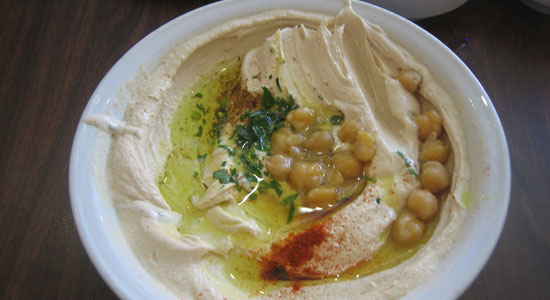
Lorincz: It’s difficult to think about being on tour without considering hummous. The staple of green-room hospitality trays, the mainstay of tour riders, lifeblood of vegetarians everywhere. Hummous is so ubiquitous that it’s easy to overlook; there’s certainly enough mediocre stuff around to take it for granted. My take on hummous was lukewarm at best, until I visited Israel several years ago. It’s not much of an exaggeration to say that Israel has one of the best food cultures in the world, featuring and sometimes blending Middle Eastern, Persian and European cuisines, among others. On my first day in the country, I was taken by my visibly excited brother-in-law, Hadar, to Abu Hassan, an appealingly threadbare hole-in-the-wall in Jaffa, the largely Arabic city that abuts Tel Aviv. It was lunchtime, and we queued up with street vendors, office workers and housewives who had brought their own bowls to take home.
I was intrigued, but mostly wondering how good a large bowlful of hummous could actually be. On Hadar’s recommendation, I ordered “Msabbha,” a slight variation on hummous that includes whole chickpeas. (Purists regard it as an entirely separate class of food, but it’s possible they’re thinking about hummous too much.) I’m not sure if my life was changed on that day, but I’ll tell you this: I will never think about hummous the same way again. Served warm (!) in a bowl, with freshly baked little pita breads and wedges of small white onions (grown exclusively for the restaurant, or so it’s claimed), the meal was one of the best I’ve had in my life. Richer than American versions (the best tahini is supposedly from Nablus, in the nearby West Bank), flavored with dashes of vinegary pepper sauce (the only condiment I can recall), it was unbelievably filling and somehow never monotonous.
Here’s a site devoted to the food, with a short video dedicated to Abu Hassan. The introductory scenes of frolicking beachgoers are gratuitous, at best, and the lip-smacking scene at 1:08 makes me want to throw up in my mouth. But it will give you a little bit of the flavor of this remarkable restaurant, and remarkable food.
Video after the jump.