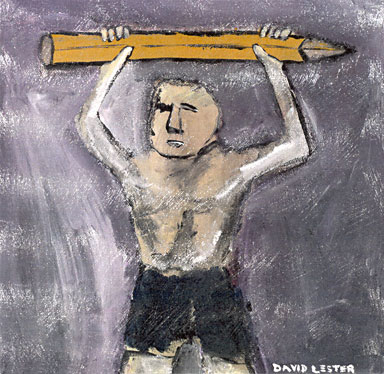
 Every Saturday, we’ll be posting a new illustration by David Lester. The Mecca Normal guitarist is visually documenting people, places and events from his band’s 25-year run, with text by vocalist Jean Smith.
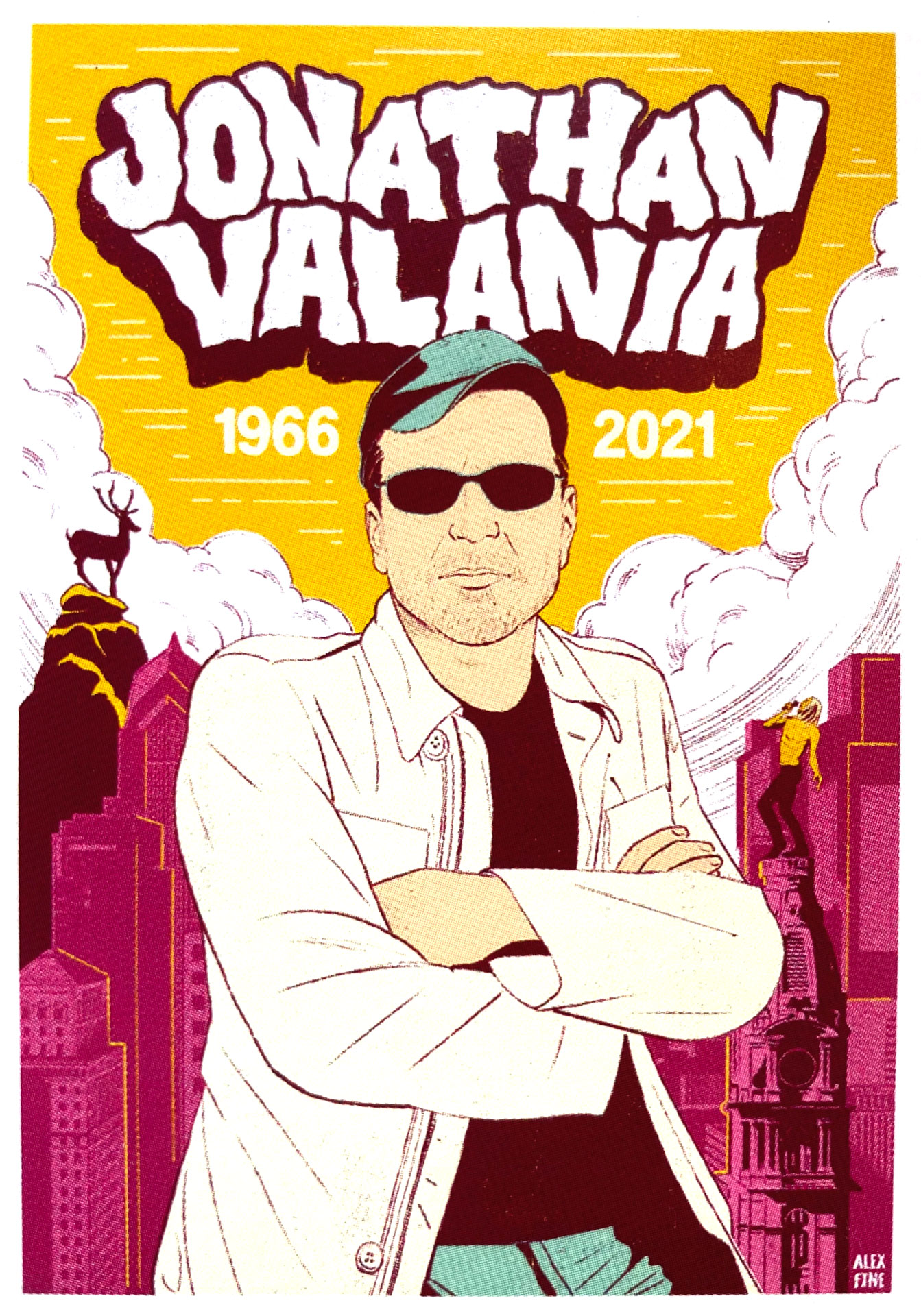
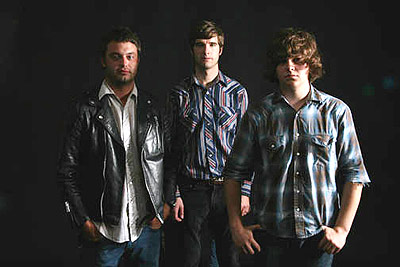
David’s illustration is about the Industrial Workers of the World (IWW) currently headquartered in Cincinnati, Ohio — just down the road from Dayton, where Swearing At Motorists played a song-by-song run-through of Number 7 Uptown last night with original drummer Don Thrasher. dave doughman is back in the USA for one show only.
We met dave in Toronto, in 2001. He was Unwound’s excellent live sound man. Mecca Normal was joining the tour to open shows from there to Atlanta. This was a few days before 9/11 — we lost our Boston and Manhattan shows, but play on 9/13 in Hoboken, at Maxwell’s, where Unwound’s music is profoundly soothing. dave starts doing Mecca Normal’s sound too, because he likes us. He wants us to sound good.
In Philly, Mecca Normal stays the night at the huge space dave shares with his drummer Joseph. dave puts on a Swearing at Motorists CD, the incredible Number 7 Uptown. I love this album — the sound of it, the sound dave gets — and I know I want to work with him in some way. Mecca Normal leaves the tour in Atlanta, driving north to Toronto to fly home to Vancouver.
dave and I hatch a plan to record at Unwound’s studio outside Olympia. I rent a car and drive four hours south to hear what our voices will sound like together. At Farm No Heat I am given a room with a mattress on the floor, a room where they put all the stuff they took out of the basement — piled it in, worse than random. Going to sleep is a matter of putting on a jacket, hat and gloves, to lie in my sleeping bag, waiting for warmth. Come on warmth. Just enough to fall asleep.
dave sleeps in the living room, where tomatoes are ripening on a blue tarp over the bright green shag carpet. On day two, dave makes a geometric shape with the ripe tomatoes, to see if anyone notices. No one does, because none of the residents stay at Farm No Heat. They have gone to their girlfriends’ places in town where there is heat.
Tally of furniture in the living room — three big couches, two matching chairs, and an oddly stylized painting of Muhammad Ali. One of the chickens in the yard is called Cassius Clay.
In the basement, the recording studio control room eventually gets warm. We stay in there, inventing guitar tracks, passing my 1960-something Martin 0-18 between us, over-dubbing vocals, deciding to call our duo Transmarquee because we’d both owned 1980-something Grand Marquees as touring vehicles.
On day three, Justin, Vern and Brandt of Unwound come to see how we’re doing. Vern asks about the white powder laid out in the control room. It’s baby powder. I use it on my hands, for playing guitar. OK, so I made it look like a bunch of coke. Hey, I’m straight edge, man — gotta get my thrills somehow.
dave comes to Vancouver to record and produce the next Mecca Normal album — The Family Swan — the songs he mixed night after night on tour. Who better to record them? dave gets great guitar sounds and we love working with him. Finishing the album in three days, dave gets on a bus to the airport — LA, Dayton, everywhere — touring until we meet in San Francisco where Mecca Normal finally sees Swearing At Motorists play at the Bottom of the Hill. dave’s great warmth is matched by giant leaps in the air that look as necessary as barré chords, crucial to guitar playing.
Out of all this action and chaos, two gestures stick in my mind, describing dave. 1.) Standing outside at Farm No Heat, waiting for Unwound to do something in the studio, waiting to get back in there, dave’s cell phone rings. He puts a finger in his ear. It isn’t a good connection. A friend asks dave how to do something, how to set something up to record. dave is incredibly helpful and patient, giving her information and encouragement. 2.) After losing the show in Boston, Mecca Normal didn’t have a place to stay. dave hands me his Red Roof Inn guide from the window of their van. 9/11 crisis all around us, it’s more than a list of motels; he is extending the universal map of help.
“Give me ten minutes and we’ll be friends.” — Hex or No Hex, Transmarquee
“I have a plan. I’ll draw a map when I get to where I’ve been. For now, I’m not lost — I just don’t know what things mean.” — Don’t Be Another Double String of Fake Pearls, Transmarquee
On the weekend, I went across town to Zulu Records to see political singer/ songwriter Billy Bragg. A free, rainy afternoon in-store. The place was packed.
Dave found out about Billy Bragg in 1985 reading the U.K.’s NME. We had been doing Mecca Normal for a year or so, unaware that Bragg was doing a voice-and-abrasive-guitar thing with political lyrics—this was unusual in those days, between the wars, and for many years Mecca Normal was compared to Billy Bragg in reviews and articles.
In 1986, just after we released our first LP, we went to play in Montreal. We did an interview at CBC Radio (Canada’s national radio network), where we heard that Billy Bragg was part of the Red Wedge in the U.K.: socialist musicians on tour to encourage people to vote for the Labour Party in the U.K.’s 1987 elections, in order to oust the Conservative Party from power. We were inspired by this idea—musicians and poets working together based on similar political beliefs. We formed the Black Wedge that night, there in the basement of the CBC, and toured the U.S., Canada and the U.K. in the following years to illuminate our underground and anti-authoritarian ideas.
At the record store, 51-year-old Billy looked and sounded great—he did about a half dozen songs and turned the chorus of his most famous single, “A New England,” into a sing-along. “I don’t want to change the world/I’m not looking for a new England/I’m just looking for another girl.” From my vantage point, beyond Bragg, several young women sang with delight, but I wondered if the protagonist’s perspective—the guy in the song—was perhaps lost on them, when, in this era, the idea of being able to change the world has been relegated to unrealistic, while the concept of participating in a re-structuring of society has been set aside for immediate comforts. “I don’t want to change the world/I’m not looking for a new England/I’m living with my folks, looking for a cell-phone plan.”
If it’s possible to detect the difference between lower case and capital letters in aural communication, I got the impression people were singing “I’m not looking for New England”: the region north of New York state or the white clam chowder as opposed to the Manhattan red. A place on a map and a bowl of soup are easy, tactile associations; a new England is a more complex prospect to grapple with. Please pass the Rand McNally’s and the Tabasco.
Or maybe it’s that thing that happens when the sound of a song becomes synonymous with its purpose. Lyrics turn into agreeable noises to be chanted without connecting them to the words—their actual, undeniable and important meaning. Seems to me that the song’s purpose was to foist an average youth, circa 1983, into our awareness, to expose a vignette of apathy within the human condition—not to celebrate the guy’s decision to opt out in favor of finding a new girlfriend.
I guess the young women were enthralled in the moment, part of this rendition and probably their views click with Bragg’s, so I’ll focus on my experience, which definitely included a wave of nostalgia, not for the days of overtly political songs, but simply for those days, that time—the thrill of seeing Billy Bragg at the Town Pump in 1986 or so, feeling hopeful and encouraged, part of something.
I didn’t sing along at the record store, but I noticed that I was one hell of a lot closer to the I-can’t-change-the-world-clam-chowder interpretation than I felt comfortable with. My conclusion is that we need new political songs to add to the ones that may become diluted by becoming popular. The friendlification factor has a way of putting intention and meaning on the back burner.
In an article online, Bragg explains the song “I Keep The Faith” from his 2008 album, Mr. Love And Justice: “In it I talk about the faith I have in the ability of the audience to change the world,” says Bragg. “I recognize that my role is to inspire them. But really, the important thing is what happens when I step down from the stage—empowering the audience to make progressive change in the world. We all feel cynicism from time to time. But when you encourage people to overcome that, telling them you have faith in their ability, it’s a powerful message.”


 With the release of major-label debut What Will We Be (Warner Bros.), Devendra Banhart proves once again he has the potential to be one of his generation’s major players. His voice, with its careening vibrato and fuse-blowing intensity, sounds something like Marc Bolan’s, but his repertoire may be more all over the map than anyone making records today. He combines a love of arcane folk music with hard-rocking psychedelia and an ability to sing beautifully in English or Spanish, a skill he learned growing up in Caracas, Venezuela. He refers to himself, jokingly, as a “fake hippie,” but he appears to be the real thing, a refreshing return to the revolutionary thinking that once seemed capable of changing the course of human events. Who’s to say it couldn’t happen again? Banhart is guest editing magnetmagazine.com. Read our Q&A with him. For his posts this week, Banhart will be sharing 60 videos that are dear to his heart.