Ever wonder what will happen during the last five minutes of late-night TV talk shows? Here are tonight’s notable performers:
The Late Show With David Letterman (CBS): Care Bears On Fire
If teenage girls are still as angsty as we remember, it’s a surprise Care Bears On Fire aren’t a hardcore band. The pop/punk trio makes its network-TV debut tonight on Letterman, promoting its second album, Get Over It (S-Curve).
The Tonight Show With Conan O’Brien (NBC): Franz Ferdinand
Tonight: Franz Ferdinand (Domino) came out in January, but new single “Can’t Stop Feeling” is the big thing now. After tonight, the band will be playing a few festivals in the U.S. before touring Canada, then going back over the Atlantic.
Jimmy Kimmel Live! (ABC): Matt And Kim
The Brooklyn indie-pop duo will be on Kimmel tonight, also making its network-TV debut (not including the various commercials that feature its songs). Matt And Kim will be playing something from their latest album, Grand (Fader).
Rock Plaza Central‘s 2007 album Are We Not Horses was an elaborately plotted and immaculately conceived album that brought the Toronto band’s Northern-gothic folk/rock accolades from both critics (MAGNET named it one of the year’s 10 hidden treasures) and academics (frontman Chris Eaton’s 2004 book The Inactivist was taught alongside Horses in a graduate English course at the University of South Alabama). Last month, RPC hit the road to support the release of this year’s … At The Moment Of Our Most Needing, and bassist Scott Maynard filed a tour diary for magnetmagazine.com. If you missed Rock Plaza Central this summer, catch the group on its U.S. tour with the Weakerthans in September.
Wisconsin, July 23
Currently approaching Madison, Wisc., we have driven more than 1,600 miles in the past few days in an attempt to get from Vancouver, B.C., to the Hillside Festival in Guelph, Ont., in time for our 6 p.m. workshop on Friday evening. Last night we opened the 10,000 Lakes Festival in Detroit Lakes, Minn. We arrived from Bismarck, N.D., at about 4 p.m., set up, ate, played, hung out for about an hour, then got back in the van and drove over the Wisconsin state line to find a place to sleep. Otherwise, the past few days have been relentless driving.
There are many activities that can help to pass the time on a long drive. Chris and I are honing our Sudoku skills with the goal of finishing the most difficult ones without making any notes. (I am proud to report that I achieved this for the first time yesterday, somewhere in Minnesota. Now what?) There are several books in the van. Some of them are permanent fixtures (Songwriters On Songwriting, and a collection of Rumi’s poetry), some of them get passed around, then replaced, and some of them are in Hungarian and are therefore of only a passing interest to anyone but Fiona.
There are also four iPods in the van. We are all fans of the NPR show Wait Wait Don’t Tell Me, so Chris has stuffed his with past episodes. While Fiona assures us that there’s a wide variety of music on hers, it seems to favor Bob Dylan, Neil Young, Tom Waits and Nick Cave. Don (Murray, mandolin/trumpet/guitar player) prefers ’80s music, so I’ve come to expect U2, Peter Gabriel and the Police from him. Having cleverly poured water on my newer iPod, I’ve had to revert back to my old 16G, which necessitated a culling of the ever growing mp3 collection. Yesterday we got through Wire, Sonic Youth, the Pixies, among others. Today, however, is a classic-rock radio day, given that we are passing Chicago, home of our favorite classic-rock station, appropriately called The Drive.
We took my old friend Dan Restivo on a trip out east one winter and played quite a bit of cribbage, but cards can be difficult to maneuver in a van, so this tour has seen an extended and somewhat lackadaisical game of “Cow Cow.” Here are the rules of Cow Cow, as taught to me by Spencer Musselhead on my very first inter-provincial road trip, way back in 1993:
•A game goes to ten points
•When you pass a field of cows, the first person to say “cow cow” gets one point
•If you see a single solitary cow, that’s a “rogue cow,” worth five points
•A cemetery is “dead cow” and everyone else loses their points
•A three-dimensional representation of a cow is “monolith,” worth 10 points and the game
Hours of entertainment, I assure you. Beautiful scenery notwithstanding, these long drives are pretty mundane. Stop every couple of hours for a pee or to get some food. Switch seats to really liven things up. Sleep. And on that note …
Nostalgic rock stars don’t ask for much. In fact, a simple “please” will suffice for Monsters Of Folk, the teaming of Bright Eyes’ Conor Oberst and Mike Mogis, Jim James of My Morning Jacket and singer/songwriter M. Ward. To download “Say Please,” the kitschy, band-of-brothers-gone-a-little-too-choral-concert single off the quartet’s self-titled debut album (out next month on Shangri-La Music), just say the magic word.
Richard Thompson has taken the concept of celebrated obscurity to new levels over the last four decades. As such, his unwieldy catalog has never really lent itself to the “greatest hits” format (never mind that he hasn’t enjoyed anything resembling a legitimate hit). Walking On A Wire: Richard Thompson (1968-2009) (Shout! Factory) may be the closest any compilation comes to reining in his all-encompassing creative reach as songwriter and guitarist. The four-CD boxed set covers every phase of his career so far. From his ’60s stint with seminal folk-rockers Fairport Convention to his critically fawned-over duo albums with then-wife Linda to his 20-plus years as a solo artist, no Thompson album goes unrepresented. In the process, the full scope of his varied stylistic wanderings is evident, whether it’s rock, jazz, rockabilly, classical, movie scores or live recordings. Naturally, it helps immensely that Thompson himself was heavily involved in the project—and rest assured he wouldn’t have it any other way. MAGNET caught up with Thompson at home in Los Angeles as he prepared to hit the road in support of Walking On A Wire.
MAGNET: Forty years of Richard Thompson on four CDs. How does it feel do have your entire career thus far condensed to 71 tracks? Thompson: It’s always a bit arbitrary. One would like to think that one is more than a mere box—unboxable. But a box is good enough for now, anyway. It’s sort of a sample of what you can do.
How did you go about the song-selection process? It’s really Shout! Factory’s, and I had veto power and made some suggestions. I’m not sure if I’d be comfortable trying to do my own selection. I don’t even know what I’d put on it. I might pick stuff that’s obscure, which is not what record companies want to see. There has to be an interface between you and the public, and you have to accept that sometimes what you think isn’t necessarily accurate.
You’ve been called a prolific songwriter. Yet, in light of your prodigious output, you’ve been quite successful in stressing quality over quantity. I try to be discriminating. These days, I try to write less and really mean everything that I write—to make every song count. I’d like to think that I’m a better craftsman now. As for inspiration, who knows?
Over the years, you’ve been equally praised as a guitarist and a songwriter. Which gives you the most joy? I think of myself primarily as a songwriter, and I try to bring the other skills into the songs. If I’m any good as a guitar player, it’s more as an accompanist and occasional soloist than as a virtuoso. But you don’t have to be a virtuoso to be good.
You’ve managed a certain iconic status while not necessarily having to endure the many annoyances that come with superstardom. I’d imagine that, at this stage of your life, you’re OK with that. But was it always that way? It’s really about playing music. I always thought the other stuff was incidental. It’s not something you can hang onto; it’s an elusive thing. It can come and go very quickly. But if you can be a craftsman and stick to what you believe in, the work you do is rewarding enough. And if you’re busy, you shouldn’t have time to think about the other stuff.
If we were to gauge your so-called commercial success, most of it came in the ’80s and ’90s when you were with Capitol. How do you look back on that period? It was fun; I was having a good time in the studio. I suppose, being on a major label, there was a little more pressure to produce something that was radio friendly. They’re also more America-friendly, a little less British folky. Just about every album I’ve ever done is uneven—there are some good tracks and bad tracks.
I read that you’re working on an orchestral piece. It premiered in June at Penn State. It’s a commission by the International Society of Bassists—you probably didn’t think there was one, but there is. It’s a piece that features the double bass. It’s a song cycle, about 70 minutes of music. It’s called “Cabaret Of Souls.” I worked on it for about a year. I’d never done orchestration of that size, so it was a lot of work.
Apparently, you’ve been less than thrilled with some of the recent reissues of your older albums. To me, the best reissues are the ones without all the bonus tracks. There are reasons you leave songs off a record. I’d rather it didn’t happen.
Any plans on writing a book? The pieces on your website are a real delight. If everything is going well, you can write a song in 10 minutes. Writing a book, you have to set aside six hours a day for two years, then you have rewrite it again if it’s crap. I don’t know if I want to get into that world. I’d be happy writing a play.
You’re touring behind the new boxed set. Um, yes. It’s hard to say when the last tour ended and the next one begins. It’s basically been the same tour since 1967.
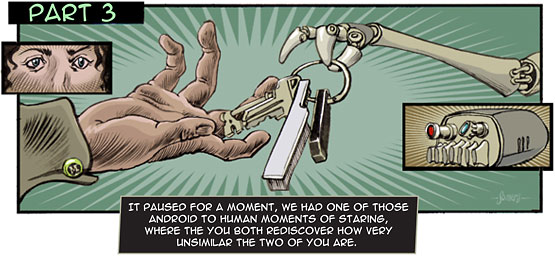
Mark Mallman is a musician of great endurance (he’s performed 52-hour marathon shows consisting of a single song) and great eccentricity (he sometimes appears as his lupine alter ego, Mallwolf). Now, as a companion piece to his most recent album Invincible Criminal (out on Badman and featuring guest vocals from the Hold Steady’s Craig Finn), Mallman has emerged as a great storyteller with a graphic novel due early next year. Featuring Marvel comics-style artwork by Stephen Somers, The Incredible Urban Myth Of The Invincible Criminal is being presented on magnetmagazine.com as an audio book with daily installments throughout the week. Read parts one and two.
“The Incredible Urban Myth Of The Invincible Criminal Part 3” (download): https://magnetmagazine.com/audio/TheIncredibleUrbanMythOfTheInvincibleCriminalPart3.mp3
Some people talk about salad days; these were my savage days. My head would throb like a blistery acid trip. Noon time found me with nothing more to do than plot and scheme. Outside, someone was listening to a very odd rendition of Crosby, Stills, Nash & Young. It was warbled and distant, yet intimately nearby—sounding more and more like it was coming from inside of the apartment, and less and less like it was coming from outside down below. Yes, in fact, the music was coming from somewhere very close by and began to sound like it was coming to me through a headphone. The more I listened to it, the more it began to sound like the music was coming directly out of me. As if my head were a loudspeaker, and CSNY was being sucked out, backwards, through my left ear. I tried to move, but was frozen still—paralyzed. A horror came over me. Straining to the left, I was witness to a shocking display. A vampiric succubus was hunkered at my side. Jetting from the center of its face was a smooth black cylinder, like a needle. This stinger had been surreptitiously inserted into my ear, and the villain was feeding.


 Ever wonder what will happen during the last five minutes of late-night TV talk shows? Here are tonight’s notable performers: